
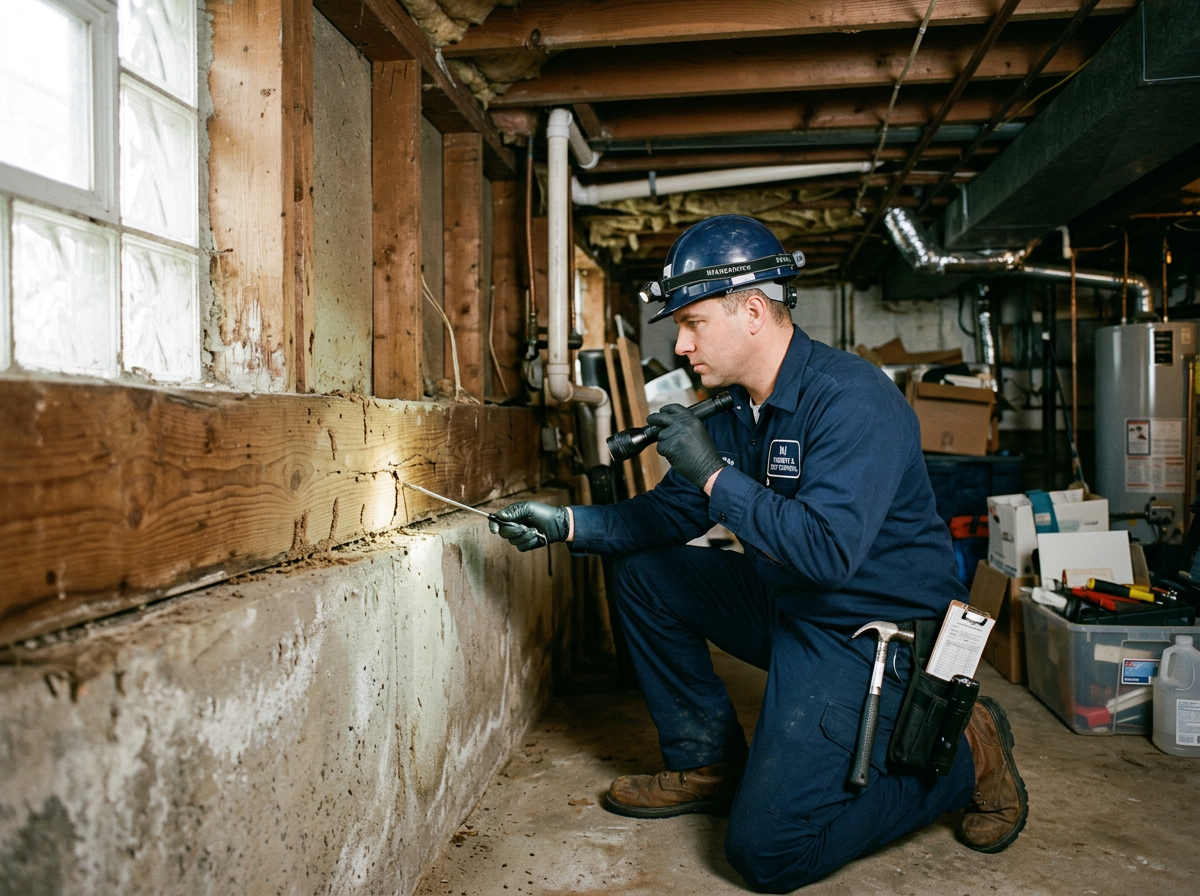
Eastern subterranean termites move through soil and enter New Jersey homes at foundation cracks, expansion joints, and utility penetrations where wood meets ground. In Parsippany and similar towns with pre-war frame houses and rowhomes, inspectors look for mud tubes along basement walls, sill plates, and behind insulation rather than relying on surface sightings alone. Real estate closing inspections require probing accessible wood members and noting moisture conditions that allow colonies to persist.
Treatment often fails when tubes are missed behind finished surfaces or when soil treatment cannot reach under concrete slabs common in older multi-family buildings. Heat reaches poorly in dense harbourage because termites stay below grade, so most jobs combine targeted liquid applications with monitoring stations. Access through tight crawl spaces and shared walls in adjoining units frequently determines whether the inspection can be completed in one visit.
Termite Inspection Near You — Choose Your City
Every city below has its own local Termite Inspection page with coverage details.
Monmouth
Ocean
Monmouth County
Ocean County
Bergen
Burlington
Other areas
Union
Morris
Passaic
Camden
Bergen County
Somerset
Middlesex
Middlesex County
Commuter corridors and frequent property transfers mean many inspections happen under time pressure before closings, limiting how much wall or floor covering can be removed. Technicians document active versus inactive tubes and note conditions like poor grading that keep soil wet against the foundation. Follow-up recommendations focus on fixing those entry points instead of promising complete elimination from a single visit.
Technician insight
In Parsippany the thing that catches most people out with Termite Inspection is the old stone foundations where termites travel behind parging and insulation without leaving visible tubes on the finished side.
Parsippany rowhome closing inspection
Buyer ordered inspection before settlement on a 1920s multi-family building. Mud tubes were found along the shared foundation wall in the basement. The report noted active termites and recommended soil treatment plus moisture correction before closing.
Termite Inspection Services We Offer
✓Real Estate Closing Inspection
Full crawl, basement, and accessible attic check that documents mud tubes and wood damage for mortgage and title requirements.
✓Annual Inspection
Yearly re-check of monitoring stations and soil contact areas to catch new activity before it spreads through shared walls.
✓Wood-Destroying Insect Report
Standard WDI form completed for real estate transactions that lists findings and any recommended corrective actions.
✓Crawlspace and Basement Assessment
Targeted look at soil-to-wood contact, plumbing penetrations, and moisture issues common in older New Jersey foundations.
✓Multi-Unit Property Inspection
Coordinated check of adjoining units where termites travel through shared foundations and utility chases.
How it works
- 1
Site Walk And Exterior Review
Technician examines grading, gutters, and foundation perimeter for soil contact and possible entry points.
- 2
Interior Probing And Tube Search
Accessible wood members, sill plates, and baseboards are probed while looking for active or inactive mud tubes.
- 3
Crawlspace And Utility Check
Plumbing and electrical penetrations are inspected for damage and conditions that support termite activity.
- 4
Documentation And Report
Findings are recorded on the required form with notes on moisture, access limits, and any recommended next steps.
Pricing
Property size, crawlspace or basement access, and whether the inspection is for a real-estate closing or routine monitoring all change the work involved. We confirm what the inspection covers up front and give you a firm price before any work begins. Call (973) 576-8942 to get a quote for your property.